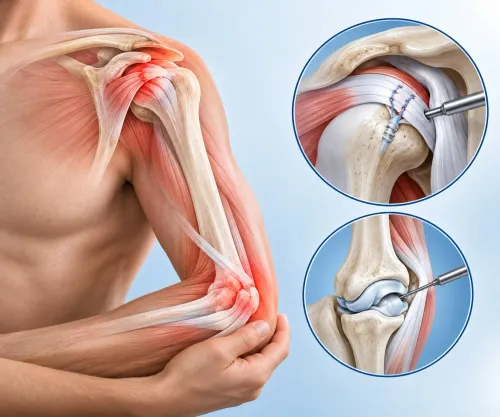
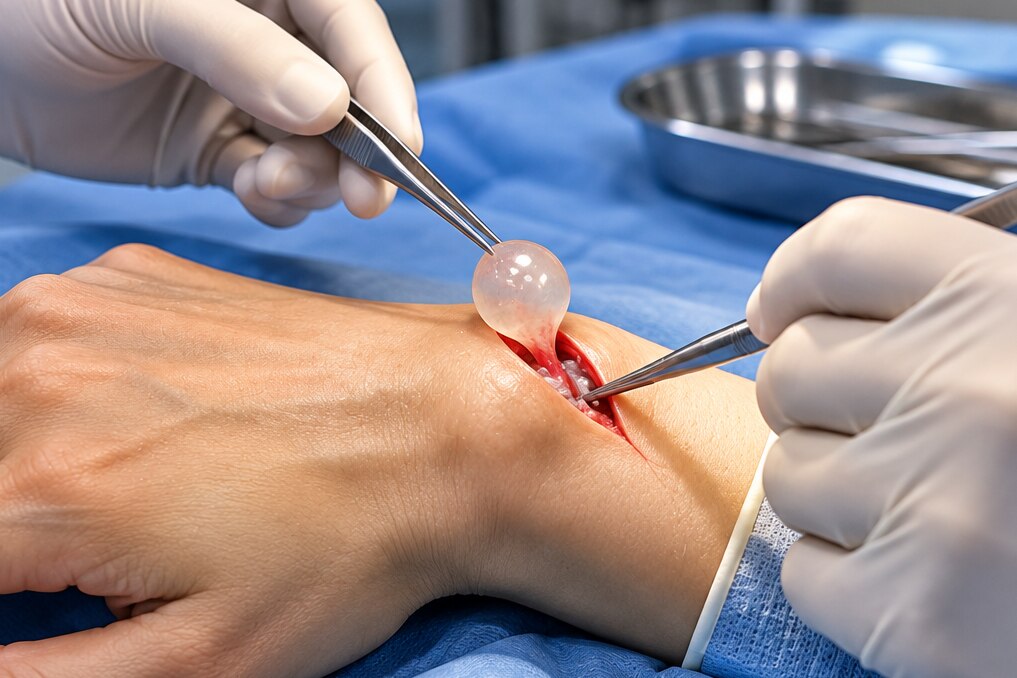
A wrist lump is not automatically a ganglion cyst, and removing the visible swelling is not the whole operation. You will learn how the diagnosis is confirmed, when observation or aspiration is reasonable, and what happens during open or arthroscopic removal, including treatment of the cyst’s stalk.
Key takeaways
- A wrist ganglion’s size alone does not determine whether treatment is needed.
- Observation suits painless cysts; aspiration has a higher recurrence risk than excision.
- Surgeons protect nearby tendons, nerves and the radial artery during wrist cyst removal.
- Seek review for worsening pain, numbness, redness, drainage or fever after surgery.
What a Wrist Ganglion Is and How the Diagnosis Is Confirmed
A wrist ganglion is a fluid-filled sac containing thick, jelly-like material. It most often appears on the back of the wrist, or on the palm side near the radial artery. Its size and position do not prove whether it needs treatment.
Diagnosis usually begins with an examination. Your clinician checks tenderness, wrist movement, nerve function, tendon function and whether the lump lights up when a torch is placed behind it, a process called transillumination.
1. Ultrasound can confirm a fluid-filled cyst and show its relationship to tendons, nerves and blood vessels. It is especially useful for a palm-side lump near the radial artery.
2. MRI helps when the lump is deep, occult, atypical or connected to the wrist joint. It gives a clearer view of the cyst, its stalk and nearby structures.
3. Plain X-rays do not show the ganglion itself. They can reveal arthritis, a bone injury or another joint problem that explains your symptoms.
This confirmation matters before wrist cyst treatment in Thane because a lump that resembles a ganglion could have a different cause. It also helps the surgeon plan safe treatment around the radial artery, tendons and nerves.
When Observation, Splinting or Aspiration Makes Sense
A painless ganglion that does not restrict movement, compress a nerve or interfere with work or sport usually needs no operation. Observation is reasonable because some cysts shrink or disappear without treatment. Arrange review if the lump grows, becomes painful, limits wrist use or causes numbness, tingling or weakness.
When movement aggravates symptoms, reduce the activity that triggers pain, use a wrist splint for a short period and take suitable pain relief as advised by a clinician. Keeping the wrist completely still for too long can increase stiffness, so follow a defined plan rather than wearing a splint indefinitely.
These measures are common options in wrist cyst treatment in Thane.
Aspiration drains the gelatinous fluid through a needle, but it usually leaves the cyst wall and its connection to the wrist joint or tendon sheath behind. The lump can therefore refill, making aspiration less definitive than excision.
A clinician must decide whether to use a steroid after aspiration; steroid treatment does not guarantee that the cyst will stay away.
Do not strike, puncture or try to pop the cyst at home. The wrist contains nearby arteries, nerves and tendons, and an apparently simple puncture can cause bleeding, infection or tissue injury.
Why a Surgeon May Recommend Removal
Persistent pain, restricted wrist motion, or reduced hand function can justify removal, even when the cyst is small. Surgery is also considered when pressure causes numbness, tingling or weakness, the lump repeatedly returns after aspiration, or it disrupts typing, lifting, driving, racquet sports or other work. Size alone does not decide the need for surgery.
| Option | Main advantage | Limitation or reason to choose removal |
|---|---|---|
| Observation | No incision or recovery period | Suitable when the cyst is painless, stable and does not affect movement, nerves or hand use |
| Aspiration | Drains the gelatinous fluid through a needle with less immediate tissue disruption | The cyst wall and its joint or tendon-sheath connection usually remain, so the lump can refill |
| Excision | Removes the cyst wall and follows its stalk or connection where possible | Requires an incision, wound care and a longer recovery, with risks such as scar tenderness, stiffness, nerve or vessel injury and recurrence |
Before choosing a ganglion cyst operation in Thane, discuss whether aspiration is likely to provide useful relief or only delay recurrence. Ask how the operation could affect wrist loading, work, driving and sport, and whether persistent symptoms or uncertain diagnosis make removal more appropriate than continued observation.
The Wrist Ganglion Surgery Process in Thane, Step by Step
The wrist ganglion surgery process in Thane begins with a consultation. The surgeon reviews pain, swelling and activity limits, examines wrist and finger movement, and checks nerve and tendon function. Imaging is reviewed when the diagnosis, depth or nearby structures need clarification. The lump is marked before consent.
1. The surgeon explains recurrence, scar tenderness, stiffness, persistent pain, infection, bleeding, and possible nerve, vessel or tendon injury.
2. In the operating room, the hand is cleaned and draped. Through a small incision, the surgeon separates the sac from nearby tendons, nerves and blood vessels.
3. The fluid-filled cyst is removed, and its stalk is followed to the joint capsule or tendon sheath. Addressing that connection lowers recurrence risk, but cannot guarantee the cyst will not return.
4. The wound is closed and dressed. Many patients go home the same day after circulation, finger movement and recovery from anaesthesia are checked.
| Anaesthesia option | What it involves | How it is selected |
|---|---|---|
| Local anaesthetic | Numbs the wrist; sedation may be added | Suitable for selected small or accessible cysts |
| Regional anaesthesia | Numbs the arm or hand | Considered for the operation and patient’s health |
| General anaesthesia | Produces unconsciousness | Used when the procedure or medical plan requires it |
How ganglion cyst removal is performed in Thane depends on the cyst and your health. At The Bone & Joints - Advance Ortho Care 08048067357, ask which imaging, anaesthetic and discharge plan applies to your cyst.
Related service
Ganglion Cyst Removal Dr. Vivek V. Shingane is an experienced Orthopaedic and Joint Replacement Surgeon offering expert treatment for ganglion cyst removal at The Bone &... View service → |
Open Excision or Arthroscopy: Which Approach Is Used?
The operation is not identical for every wrist cyst. The wrist ganglion surgery process in Thane may use open excision or arthroscopy, depending on where the cyst lies and how it connects to the wrist.
Approach | How it is performed | What determines its use Open excision | A direct incision is made over or near the ganglion. The surgeon sees and protects tendons, nerves and blood vessels while removing the sac and its attachment.
| Common for dorsal wrist ganglia; useful when the cyst is superficial or its stalk needs direct treatment. Arthroscopy | The surgeon uses small portals to enter the wrist joint and removes a selected cyst from inside the joint. | Considered when the cyst has a suitable joint connection and its position allows safe access.
Neither approach is automatically safer or better. The choice depends on the cyst’s position, depth, joint connection, nearby radial artery or nerves, any associated joint problem requiring treatment and the surgeon’s arthroscopy experience.
Before a ganglion cyst operation in Thane, ask: “Can this approach identify and treat the stalk completely?” A smaller incision does not prove that the connection has been addressed, and leaving it behind can contribute to recurrence. A larger open incision can sometimes provide safer, more complete access.
Recovery, Recurrence and Warning Signs After Hand Cyst Removal
After hand cyst removal in Thane, a dressing protects the incision while it begins to heal. Move your fingers early when the operating team permits it; this helps limit stiffness without loading the wrist.
1. Keep the dressing clean and dry as instructed. Do not lift, push, grip forcefully or repeat wrist movements until cleared. These restrictions protect the wound and the area where the cyst stalk was removed.
2. Plan your return to work or sport around pain, wrist movement, incision healing, dominant-hand use and job demands. Desk work may differ from construction, driving, racquet sports or weight training.
3. Before surgery, discuss infection, bleeding, scar tenderness, persistent pain, stiffness, nerve injury, blood-vessel injury and recurrence. A palm-side cyst can lie close to the radial artery, while a dorsal operation can leave a sensitive scar.
4. Removing the stalk or joint connection reduces recurrence risk, but it cannot guarantee the ganglion will not return. Report a new lump during follow-up.
5. Contact the operating team promptly for increasing redness, warmth, swelling, drainage, fever, worsening pain, numbness, pale or blue fingers, or inability to move your fingers. Do not wait for a routine appointment.
Frequently asked questions
How is a wrist ganglion diagnosed?
A doctor examines the lump, checks wrist movement and symptoms, and may use ultrasound or MRI to confirm its location and distinguish it from other masses.
When is observation or splinting appropriate for a wrist ganglion?
Observation suits a painless cyst that does not limit movement. A splint can reduce wrist motion and irritation when activity causes symptoms.
Why might a surgeon recommend wrist ganglion removal?
Removal may be recommended when the cyst causes persistent pain, restricts movement, compresses a nerve, returns after aspiration, or interferes with work or sport.
What happens during ganglion cyst surgery in Thane?
The surgeon marks the cyst, administers anaesthesia, makes an incision or uses a camera, removes the cyst and its connection to the wrist joint, then closes and dresses the wound.
How do open excision and arthroscopic removal differ?
Open excision uses a direct incision over the cyst. Arthroscopy uses small portals and a camera, making it useful for selected cysts connected to the wrist joint.
Keywords