The right operation depends on the diagnosis, the severity of tissue damage, imaging findings, your activity goals, and whether non-surgical care has failed. By the end, you will be able to compare the main procedures, understand when surgery is unnecessary or unsuitable, and prepare focused questions for a specialist consultation.
Key takeaways
- Continue non-surgical care when pain improves and no urgent warning sign exists.
- Match the operation to the diagnosis, not only the location of pain.
- Use examination findings and weight-bearing scans to guide procedure selection.
- Ask about recovery time, complications, alternatives, and expected function.
Do you need surgery, or is non-surgical care still appropriate?
Continue non-surgical care when pain is improving with activity modification, suitable footwear, medication, bracing, physiotherapy, or weight management, and no urgent warning sign is present. For plantar fasciitis, mild arthritis, many tendon disorders, and selected Achilles ruptures, a structured rehabilitation plan can be appropriate before surgery.
Seek urgent assessment rather than comparing elective procedures if you have:
- An open injury, obvious deformity after trauma, or inability to bear weight after a significant injury
- A cold, pale, blue, or numb foot
- Rapidly increasing swelling or severe pain that seems out of proportion to the injury
- Fever with a wound, spreading redness, or drainage
Discuss an operation when a confirmed problem continues to limit walking, work, sleep, or sport despite an adequate, diagnosis-specific treatment plan. An unstable fracture, recurrent ankle instability, a displaced tendon tear, severe deformity, or advanced arthritis can also make surgery more appropriate.
The decision depends on examination, weight-bearing X-rays or other imaging, activity goals, healing risks, and recovery demands—not the scan alone.
Before deciding which foot and ankle surgery is right for me in Thane, ask what happens without surgery, how long you need immobilisation and restricted weight-bearing, and when physiotherapy begins. Review diabetes control, smoking, circulation, neuropathy, blood-thinning medicines, previous infection, transport, wound care, and time away from work.
Seek a second opinion for irreversible surgery such as fusion, major reconstruction, or joint replacement.
Which operation fits your specific foot or ankle problem?
The diagnosis—not the body part alone—determines the operation. Examination, imaging, deformity, activity goals, and failed non-surgical care guide the foot and ankle surgery options in Thane.
| Problem | Usual operation choice | What changes the decision |
|---|---|---|
| Ankle fracture | Reduction and internal fixation with plates, screws, or a nail | Displacement, joint involvement, open wounds, and ankle stability |
| Instability | Ligament repair or reconstruction; sometimes arthroscopy | Repeated sprains, ligament quality, and associated cartilage damage |
| Achilles tear | Tendon repair or structured non-operative treatment | Tear location, gap, activity level, and medical risk |
| Plantar fasciitis | Usually no operation; selected cases may need plantar-fascia release | Persistent symptoms after footwear changes, stretching, physiotherapy, and other treatment |
| Bunion | Metatarsal osteotomy, toe correction, or first-joint fusion | Deformity angle, arthritis, and recurrence risk |
| Hammertoe | Tendon balancing, joint release, or toe fusion | Flexibility, pain, corns, and fixed deformity |
| Flat feet | Tendon and ligament reconstruction, osteotomy, or fusion | Flexible versus rigid deformity, posterior tibial tendon failure, and arthritis |
| Tendon disorder | Debridement, tendon repair, transfer, or reconstruction | Tear size, degeneration, strength, and alignment |
| Neuroma | Nerve decompression or excision | Response to footwear changes, injection, and nerve-location findings |
| Cartilage injury | Arthroscopy to remove loose tissue or treat the defect | A focal injury may respond; advanced arthritis usually will not |
| Ankle arthritis | Fusion or total ankle replacement | Deformity, bone quality, neuropathy, infection risk, and desired motion |
Ankle arthroscopy suits selected impingement, loose-body, cartilage, or instability problems, not advanced cartilage loss. A surgeon should explain immobilisation, weight-bearing, rehabilitation, footwear and work effects, and alternatives before you choose.
How do examination and scans determine the procedure?
Pain location, swelling, locking, giving way, weakness, and walking limits narrow the diagnosis, but they do not choose the operation alone. Examination tests joint movement, deformity, tendon strength, ligament stability, nerve function, circulation, and whether pain comes from the ankle or a neighbouring joint.
1. Symptoms and examination identify the failing structure. Repeated ankle rolling with a positive stability test points toward ligament repair or reconstruction; inability to push off after an Achilles tear points toward tendon repair.
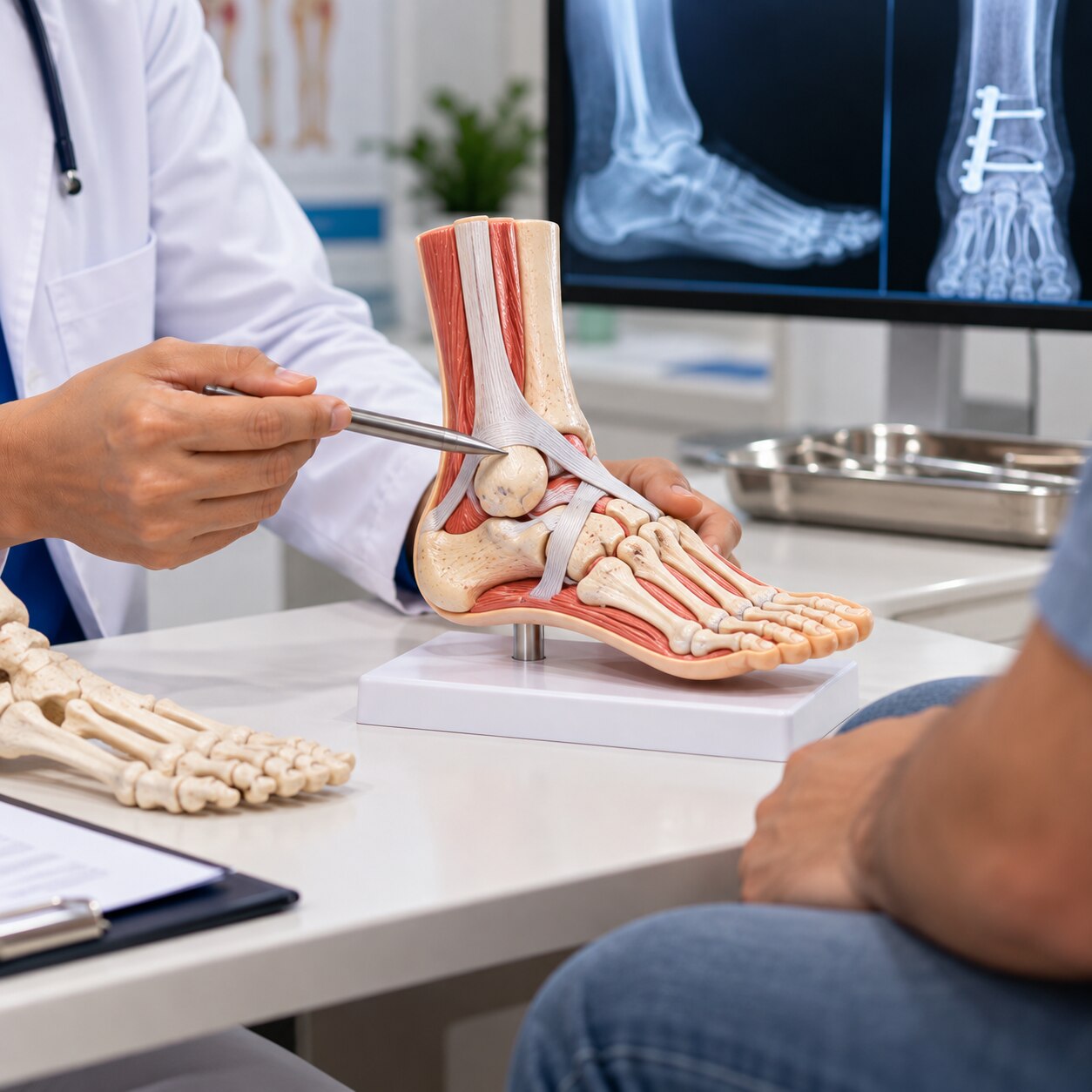
2. Weight-bearing X-rays show alignment under load, fracture displacement, joint-space loss, bone spurs, bunion angles, flat-foot collapse, and arthritis. They help decide between fracture fixation, corrective osteotomy, fusion, or replacement.
3. Ultrasound shows superficial tendon tears, thickening, fluid, and ligament movement in real time. It is useful for Achilles, peroneal, and other tendon disorders, but it does not replace a full bone assessment.
4. CT provides three-dimensional bone detail. It clarifies complex fractures, joint-surface fragments, non-union, deformity, and the bone stock needed for fixation or fusion.
5. MRI reveals cartilage injury, bone bruising, marrow disease, hidden fractures, tendon tears, ligament damage, and neuromas. It becomes important when X-rays look mild but symptoms persist.
Arthroscopy suits selected cartilage, impingement, or loose-fragment problems through small portals. Fixation stabilises a broken bone; ligament repair treats repairable tissue, while reconstruction uses a graft when the ligament cannot hold. Tendon repair reconnects torn tendon ends. These findings guide ankle operation choices in Thane more reliably than the scan label alone.
Should you choose ankle fusion or total ankle replacement?
Fusion and total ankle replacement can both relieve end-stage arthritis pain, but they solve the problem differently: fusion sacrifices ankle-joint movement for durability, while replacement preserves movement with implant-related risks.
| Option | Pain relief and motion | Durability, activity, and suitability |
|---|---|---|
| Ankle fusion | Usually strong, lasting pain relief, but removes movement from the arthritic ankle joint. | Durable for many patients; avoid running and jumping, and nearby joints may take extra stress. Useful for severe or rigid deformity, younger high-demand patients, or poor replacement candidates. |
| Total ankle replacement | Aims to reduce pain while preserving useful up-and-down ankle motion, which can improve walking mechanics. | Components can wear, loosen, or require revision. Choose lower-impact activities; it suits patients with good bone quality, manageable alignment, intact sensation, and realistic activity goals. |
Severe fixed deformity can make replacement inaccurate or unstable; fusion often handles deformity better. Poor bone quality also threatens fixation, so neither operation is automatically safe when bone is weak.
An active infection, previous serious infection, poor circulation, uncontrolled diabetes, smoking, or neuropathy raises wound, infection, loosening, and healing risks. Neuropathy is particularly concerning for replacement because reduced protective sensation can overload an implant without warning.
The decision depends on weight-bearing X-rays, deformity correction, bone stock, sensation, age, work, and activity demands. Discuss these foot ankle surgery options in Thane with a foot-and-ankle surgeon, especially because both procedures carry permanent consequences.
What should you ask during a foot-and-ankle surgeon consultation?
Ask for the diagnosis, the exact operation, and the reason it fits your examination and scans. A foot ankle surgeon consultation in Thane should also explain how long you will use a cast or boot, when you can bear weight, how physiotherapy progresses, and when footwear and work become realistic.
| Choice | What to compare | Question to ask |
|---|---|---|
| Proposed surgery | Expected benefit, restrictions, complications, re-operation rate | What happens if I do nothing? |
| Non-surgical care | Bracing, footwear, physiotherapy, medication, injections | Have I tried enough of these, and for how long? |
| Another procedure | Pain relief, motion, durability, recovery demands | Why is this option less suitable for me? |
Ask which risks apply personally: diabetes control, smoking, poor circulation, neuropathy, obesity, anticoagulants, previous infection, and any medicine that affects healing. Confirm who will manage wound checks, transport, physiotherapy, and time away from work. “Minimally invasive” describes the approach, not proof that it is safer or better.
- What restriction causes the most failures: non-weight-bearing, wound care, or missed rehabilitation?
- What complications have you seen with this operation, and how often have you needed another operation?
- Will the procedure change shoe size, foot shape, driving, or standing at work?
A second opinion is sensible before ankle fusion, joint replacement, or major deformity reconstruction, and when scans look mild but symptoms are severe. A foot surgery specialist in Thane should welcome comparison rather than simply offer a different operation.
At The Bone & Joints - Advance Ortho Care 08048067357, take the written plan and scan reports so another surgeon can assess the same evidence.
Related services
Foot and Ankle Surgery Dr. Vivek V. Shingane is a highly experienced Orthopaedic and Joint Replacement Surgeon specializing in foot and ankle surgery at The Bone & Joints. View service → |
Arthroscopy Treatment Dr. Vivek V. Shingane is a skilled Orthopaedic and Joint Replacement Surgeon offering advanced arthroscopy treatment at The Bone & Joints. View service → |
Frequently asked questions
When is non-surgical care still appropriate for foot or ankle pain?
Continue non-surgical care when pain is improving with activity modification, suitable footwear, medication, bracing, physiotherapy, or weight management, and no urgent warning sign is present. A structured rehabilitation plan can suit plantar fasciitis, mild arthritis, many tendon disorders, and selected Achilles ruptures.
How do doctors decide which foot or ankle operation is suitable?
The diagnosis, affected structure, pain pattern, joint stability, deformity, activity goals, medical history, and response to non-surgical treatment determine the operation. Different problems require different procedures, such as tendon repair, ligament reconstruction, bunion correction, fracture fixation, fusion, or joint replacement.
How do examination and scans affect foot and ankle surgery choices?
The examination checks alignment, swelling, range of motion, strength, sensation, circulation, tenderness, and joint stability. Weight-bearing X-rays show bone alignment and arthritis; ultrasound can assess tendons; MRI shows cartilage, ligaments, tendons, and bone marrow; CT provides detailed fracture and joint-bone imaging.
Should you choose ankle fusion or total ankle replacement?
Ankle fusion removes movement from the damaged joint to create a stable, pain-relieving union. Total ankle replacement preserves some ankle motion by replacing the joint surfaces. The choice depends on arthritis severity, bone quality, alignment, ankle stability, activity demands, age, and the condition of nearby joints.
What should you ask during a foot-and-ankle surgeon consultation in Thane?
Ask for the exact diagnosis, recommended procedure, non-surgical alternatives, expected pain and mobility improvement, anaesthesia plan, hospital stay, weight-bearing restrictions, physiotherapy schedule, complication risks, implant details when relevant, and the estimated timeline for driving, work, and sport.
Related services
Orthopedic Trauma Treatment Dr. Vivek V. Shingane is a skilled Orthopaedic and Joint Replacement Surgeon specializing in orthopedic trauma care, fracture management, and... View service → |
Fracture Repair Treatment Dr. Vivek V. Shingane is an experienced Orthopaedic and Joint Replacement Surgeon providing expert fracture repair treatment at The Bone & Joints. View service → |
Osteotomy Surgery Dr. Vivek V. Shingane is an experienced Orthopaedic and Joint Replacement Surgeon offering advanced osteotomy surgery at The Bone & Joints. View service → |
Tendon and Ligament Reconstruction Tendon and Ligament Reconstruction Dr. Vivek V. Shingane is a highly experienced Orthopaedic and Joint Replacement Surgeon specializing in tendon and ligament reconstruction at The... View service → |
Keywords