Age alone does not decide whether a torn tendon or ligament should be reconstructed. The useful decision depends on the injured structure, tissue quality, symptoms, medical risks, activity goals, and your ability to complete months of rehabilitation; the sections below show how to weigh each factor before choosing surgery.
Key takeaways
- Age alone does not rule out tendon or ligament reconstruction.
- Choose reconstruction when weakness or instability limits useful movement.
- Compare non-operative care and joint replacement before scheduling surgery.
- Ask how diabetes, heart health, medicines, and rehabilitation affect your risk.
When does age support or argue against reconstruction?
Age supports reconstruction when the injury causes disabling weakness, loss of active movement, or repeated joint giving-way and the person can tolerate surgery and rehabilitation. Age alone is not an automatic contraindication.
Tendons and ligaments often heal more slowly with age, while muscle weakness, fatty muscle degeneration, reduced blood supply, lower bone density, frailty, and slower balance recovery can reduce the result.
The most useful predictors are:
- Walking capacity and exercise tolerance
- Diabetes control, smoking, and obesity
- Cardiovascular and lung health
- Cognition, skin condition, and bone quality
- Ability to follow rehabilitation, with dependable family or caregiver support
Suitable injuries include acute or symptomatic rotator cuff tears, Achilles ruptures, patellar tendon tears, quadriceps tendon tears, and selected knee ligament injuries. A low-demand older adult with manageable pain and function may gain little from surgery; an active person with disabling weakness or repeated giving-way episodes may gain considerably more.
The goal depends on the tissue. Tendon surgery restores force transmission from muscle to bone and improves active movement. Ligament surgery controls abnormal joint translation or rotation. Therefore, tendon ligament reconstruction for older adults in Thane should follow the person’s functional problem, not an age cut-off or MRI finding alone.
For example, a degenerative rotator cuff tear may respond well to physiotherapy, while persistent weakness after an acute tear can support repair. An ACL tear without instability may not require reconstruction, but recurrent giving-way or pivoting goals can justify it.
What exactly is being repaired or reconstructed?
The diagnosis determines whether the surgeon repairs existing tissue or replaces tissue that can no longer function.
| Option | What it means | When it applies |
|---|---|---|
| Direct tendon repair | Reattaches a tendon to bone or joins torn tendon ends | The tear is recent, the tendon reaches its attachment, and the tissue can hold sutures |
| Tendon reconstruction | Uses a graft or transfers another tendon to restore force | Chronic retraction, scarring, fatty degeneration, poor vascularity, or an irreparable gap prevents direct repair |
| Ligament repair | Fixes suitable native ligament tissue | The injured ligament remains repairable and its attachment or tear pattern allows preservation |
| Ligament reconstruction | Replaces a deficient ligament with a graft | The native ligament cannot reliably stabilise the joint |
“Tendon-ligament reconstruction” is not one standard operation. The site, injury timing, tissue quality, joint condition, and functional goal determine the procedure; tendon reconstruction for seniors in Thane therefore requires a site-specific diagnosis.
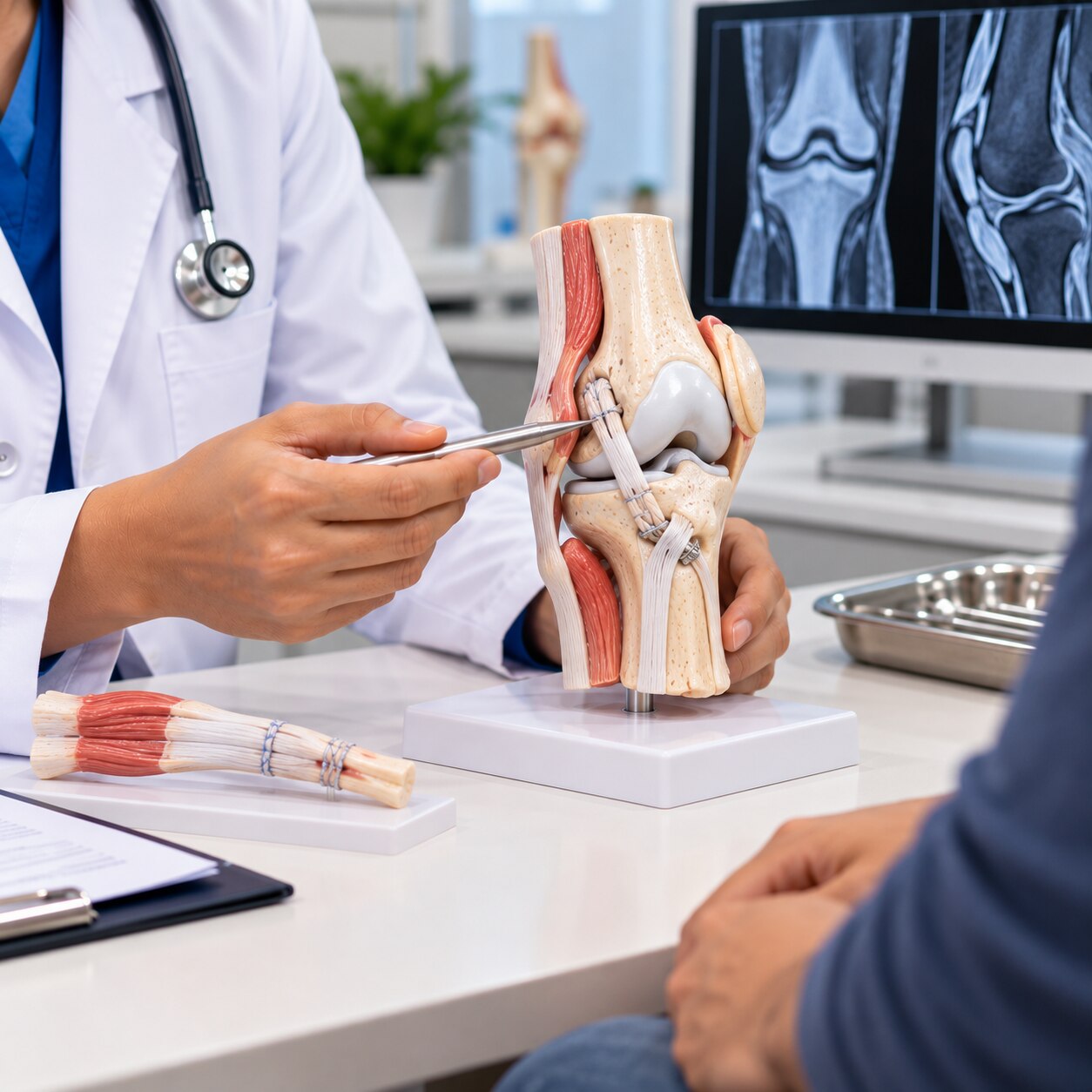
Assessment combines symptoms and examination with targeted imaging. X-rays show arthritis, alignment, or bone quality; ultrasound can assess tendon movement dynamically; MRI shows tear location, retraction, muscle quality, meniscal injury, cartilage wear, and other ligament damage. MRI cannot guarantee that a tendon will hold sutures once inspected during surgery.
The surgeon should also review walking ability, hand or shoulder use, falls, activity goals, injury timing, previous operations, and medical history. These details show whether the proposed repair addresses your actual loss of function.
When is non-operative care or joint replacement the better choice?
Start with a supervised programme when symptoms are manageable and joint stability is adequate:
- Activity modification
- Physiotherapy
- Strengthening
- Bracing
- Walking aids
- Pain medicines
- Observation
Injections suit selected conditions after a clinician reviews their risks and likely benefit.
For a degenerative rotator cuff tear, physiotherapy can improve pain and function without surgery. Repair becomes more relevant when weakness persists, symptoms follow a substantial acute tear, or you need greater shoulder strength for work or valued activities.
ACL reconstruction is not required merely because an MRI shows a tear. Recurrent giving-way episodes, a goal of returning to pivoting activities, or associated meniscal or ligament injury provides a stronger reason for ligament surgery for older adults in Thane.
Reconstruction has less value when advanced arthritis causes most of the pain, the tendon cannot hold sutures, nerve disease causes the weakness, or you cannot complete rehabilitation. Low activity demands also reduce the likely gain from stabilising a joint that functions acceptably.
Joint replacement may address the main pain generator more effectively when the knee, hip, or shoulder has advanced cartilage loss, malalignment, or severe arthritis alongside the tear. Reconstruction restores or stabilises soft tissue; it does not reverse worn cartilage. Ask whether the proposed operation treats your disabling problem or only an abnormal scan.
How do medical risks and rehabilitation change the decision?
A safe operation depends on more than age. Diabetes raises wound and infection risk; smoking or nicotine impairs tissue healing; obesity increases mechanical load and complications; and osteoporosis can weaken fixation. Heart or lung disease, previous surgery, poor skin, cognitive impairment, and frailty can alter anaesthesia, positioning, clot prevention, and discharge planning.
- Review every medicine before booking surgery. Aspirin, warfarin, apixaban, rivaroxaban, clopidogrel, and other blood thinners need a written plan from the prescribing and surgical teams. Never stop one yourself.
- Improve modifiable risks first. Discuss smoking cessation, glucose management, protein and calorie intake, and prehabilitation to build walking strength and exercise tolerance.
- Plan the home recovery. Arrange fall-proofing, suitable walking aids, family or caregiver help, and early safe mobilisation. These steps reduce deconditioning, falls, stiffness, constipation, pressure injury, and venous thromboembolism.
- Get the rehabilitation timetable in writing. It should state wound care, warning signs, permitted exercises, brace use, range-of-motion limits, weight-bearing restrictions, and when strengthening and demanding activity can begin.
Rehabilitation is part of the operation, not an optional extra. Protecting the repair often means restricted movement or loading before progressive exercises, with several months before higher-demand activity. Ask how the team will monitor infection, clots, fixation failure, and loss of mobility, and whether your medical condition makes non-operative care safer.
What should you ask a tendon ligament surgeon in Thane?
An MRI does not choose your operation, and your age does not decide it. Ask which exact tendon or ligament is injured, whether it explains your pain, weakness, instability or loss of movement, and whether examination findings match the scan.
| Option | What it means | Ask when |
|---|---|---|
| Direct repair | Reattaches torn tendon ends or native ligament tissue | Tissue is suitable and the tear is repairable |
| Graft reconstruction | Replaces deficient tissue with a graft | The ligament is inadequate or the tendon has an irreparable gap |
| Tendon transfer | Uses another tendon to restore lost force | Chronic retraction, scarring or muscle degeneration prevents repair |
| Joint replacement | Replaces an arthritic joint | Advanced cartilage loss is the main pain source |
| Non-operative care | Physiotherapy, bracing, medicines and activity changes | Symptoms are manageable or rehabilitation risk outweighs benefit |
A tendon ligament surgeon in Thane should explain the reason for the recommendation and the expected functional gain, not simply show you an MRI. Ask where the graft will come from, how often the tear proves irreparable during surgery, and what happens if reconstruction fails.
- Which anaesthetic, blood-clot prevention method and medicine changes will apply?
- What are the wound, infection and re-operation risks?
- When can you drive, climb stairs, work, walk unaided and stop using a brace?
- What is the written rehabilitation timetable, including exercises, loading and follow-up?
Match the surgeon’s experience to your body region: shoulder, knee, hand, foot and ankle, or another site. The Bone & Joints - Advance Ortho Care 08048067357 can help with a site-specific diagnosis and comparison with physiotherapy or replacement.
Seek a second opinion when the recommendation rests mainly on imaging or fails to explain your functional problem.
Related services
Tendon and Ligament Reconstruction Tendon and Ligament Reconstruction Dr. Vivek V. Shingane is a highly experienced Orthopaedic and Joint Replacement Surgeon specializing in tendon and ligament reconstruction at The... View service → |
Soft Tissue Repair Treatment Dr. Vivek V. Shingane is a skilled Orthopaedic and Joint Replacement Surgeon providing advanced soft tissue repair treatment at The Bone & Joints. View service → |
Frequently asked questions
When does age support or argue against tendon ligament reconstruction?
Age supports reconstruction when the injury causes disabling weakness, loss of active movement, or repeated joint giving-way and you can tolerate surgery and rehabilitation. Age alone is not an automatic contraindication.
What exactly is being repaired or reconstructed?
A surgeon may repair the person’s torn tendon or ligament, reconstruct it with a graft, or address associated damage such as cartilage, bone, or a fracture. Ask which structure is injured and what the operation will restore.
When is non-operative care or joint replacement the better choice?
Non-operative care may fit when symptoms are manageable and strength or stability can improve with physiotherapy, activity changes, or medication. Joint replacement may fit when advanced arthritis causes pain from damaged joint surfaces rather than an isolated tendon or ligament injury.
How do medical risks and rehabilitation change the decision?
Your surgeon should assess heart and lung disease, diabetes, bone quality, blood-thinning medicines, infection risk, and your ability to complete rehabilitation. Recovery can require weeks of protection followed by months of strengthening.
What should you ask a tendon ligament surgeon in Thane?
Ask which structure is damaged, whether repair or reconstruction is needed, what happens without surgery, the expected improvement, surgical risks, immobilisation period, physiotherapy schedule, and signs of complications.
Keywords