An accident injury needs more than a pain check when bleeding, circulation, sensation, movement, or the spine may be affected. You will learn which signs require emergency care, what to do before help arrives, when same-day orthopedic assessment is reasonable, and what evaluation and follow-up involve.
Key takeaways
- Call 112 immediately for severe bleeding, breathing trouble, unconsciousness, or a deformed limb.
- Keep the injured person still and support the injured area without straightening it.
- Choose emergency care for suspected spine, head, chest, or severe limb injuries.
- Bring scans, prescriptions, identification, and details of medicines and medical conditions.
Which accident injuries require emergency help immediately?
Call India’s unified emergency number 112 for orthopedic trauma care after an accident in Thane when any danger sign appears. Do not wait for a routine appointment.
- Uncontrolled bleeding, an open wound near a suspected fracture, visible bone, or severe limb deformity.
- An absent pulse, or a limb that is pale, blue, cold, or otherwise discolored.
- New numbness or weakness, paralysis, breathing difficulty, unconsciousness, or multiple injuries.
- Head injury with confusion or repeated vomiting.
- Severe neck or back pain, midline spinal tenderness, loss of balance, or loss of bladder or bowel control.
Emergency teams address airway, breathing, circulation, neurological status, and life-threatening bleeding before definitive orthopedic treatment. Do not encourage walking or repeatedly move the neck when a spinal injury is possible.
An orthopedic trauma specialist in Thane is relevant for suspected fractures, dislocations, pelvic or spinal injuries, tendon or ligament disruption, and multiple injuries. A suspected life-threatening injury needs emergency services first.
| Situation | What it can indicate | Correct action |
|---|---|---|
| Life-threatening signs or multiple injuries | Bleeding, vascular or nerve damage, spinal or internal injury | Call 112 and go to emergency care |
| Stable, closed injury with intact pulse, sensation, and strength | Possible fracture, dislocation, or soft-tissue injury | Arrange same-day orthopedic assessment |
Escalating or disproportionate pain with a tense, swollen limb, or pain during passive stretching, can signal acute compartment syndrome. It can occur with a normal-looking limb and normal X-ray, so seek emergency reassessment immediately.
What should you do before the injured person reaches hospital?
1. Call 112 immediately. Tell the dispatcher the exact location, accident mechanism, number of injured people, and whether anyone has heavy bleeding, is unconscious, or has breathing trouble.
2. Do not move the injured person if a neck or back injury is possible. Keep them still and wait for trained help; walking or repeatedly turning the neck can worsen spinal damage.
3. Press firmly and continuously on external bleeding with clean or sterile material. For an open fracture, cover the wound without probing it or repeatedly lifting the dressing.
4. Support a suspected fracture in the position found using a splint or padding, and keep the person still. Remove rings, watches, and tight clothing before swelling increases.
5. Use a cold pack wrapped in cloth for swelling. Never place ice directly on the skin.
6. Do not straighten a deformity, push exposed bone under the skin, massage a suspected fracture, force a dislocated joint back into place, or encourage walking on a painful leg. Do not give food or drink when sedation or surgery could be needed.
Emergency fracture care in Thane for an open fracture includes circulation and sensation checks, intravenous antibiotics, tetanus assessment, wound protection, and urgent surgical review. An open fracture remains an emergency even when the wound looks small.
When is an emergency department necessary, and when is same-day orthopedic review enough?
| Choice | Use it when | Why |
|---|---|---|
| Emergency department | Shock, serious bleeding, open fracture, absent or altered circulation, loss of sensation or strength, severe deformity, a visibly dislocated joint, suspected spinal-cord damage, head injury, chest or abdominal trauma, airway problems, multiple injuries, or rapidly worsening pain and swelling | These signs can indicate life-threatening bleeding, vascular or nerve damage, internal injury, or a condition needing immediate reduction or surgery |
| Same-day orthopedic review | The injury is stable and closed, bleeding is controlled, the person is alert, circulation and sensation remain intact, and there is no concern about the head, neck, chest, abdomen, or spine | A specialist can assess possible fractures, dislocations, ligament injuries, and tendon damage without delaying emergency treatment |
An outpatient clinic is not equipped to manage unstable vital signs, major blood loss, airway compromise, or serious internal and neurological trauma. Choose emergency care for accident injury treatment in Thane whenever the mechanism or symptoms create doubt; do not wait for a routine slot.
A normal-looking limb does not rule out a fracture, dislocation, ligament injury, or spinal injury. The ability to walk does not rule them out either, particularly after a road accident or fall.
Same-day review is reasonable only after these emergency risks have been excluded. If pain or swelling is rapidly increasing, treat that change as an emergency even when the first appearance seems reassuring.
How will the injury be assessed when you arrive?
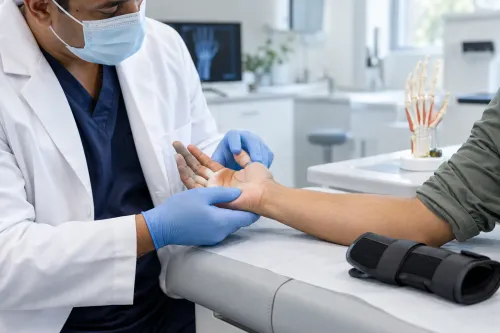
Assessment starts with repeated checks of circulation, sensation, and movement, because swelling or a developing vascular or nerve problem can appear after arrival. The clinician examines the entire limb, not just the painful spot: skin colour and temperature, swelling, wounds, deformity, blood vessels, nerves, tendons, ligaments, and function above and below the injury.
Imaging answers different questions:
| Test | What it shows | When it helps |
|---|---|---|
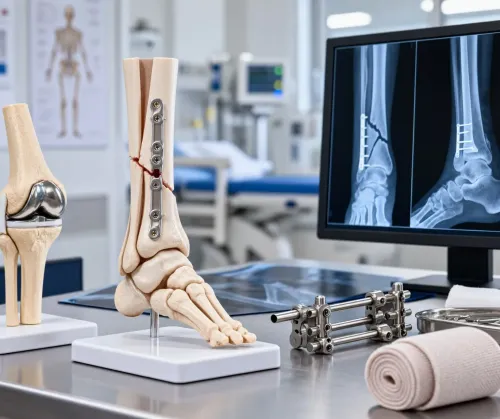
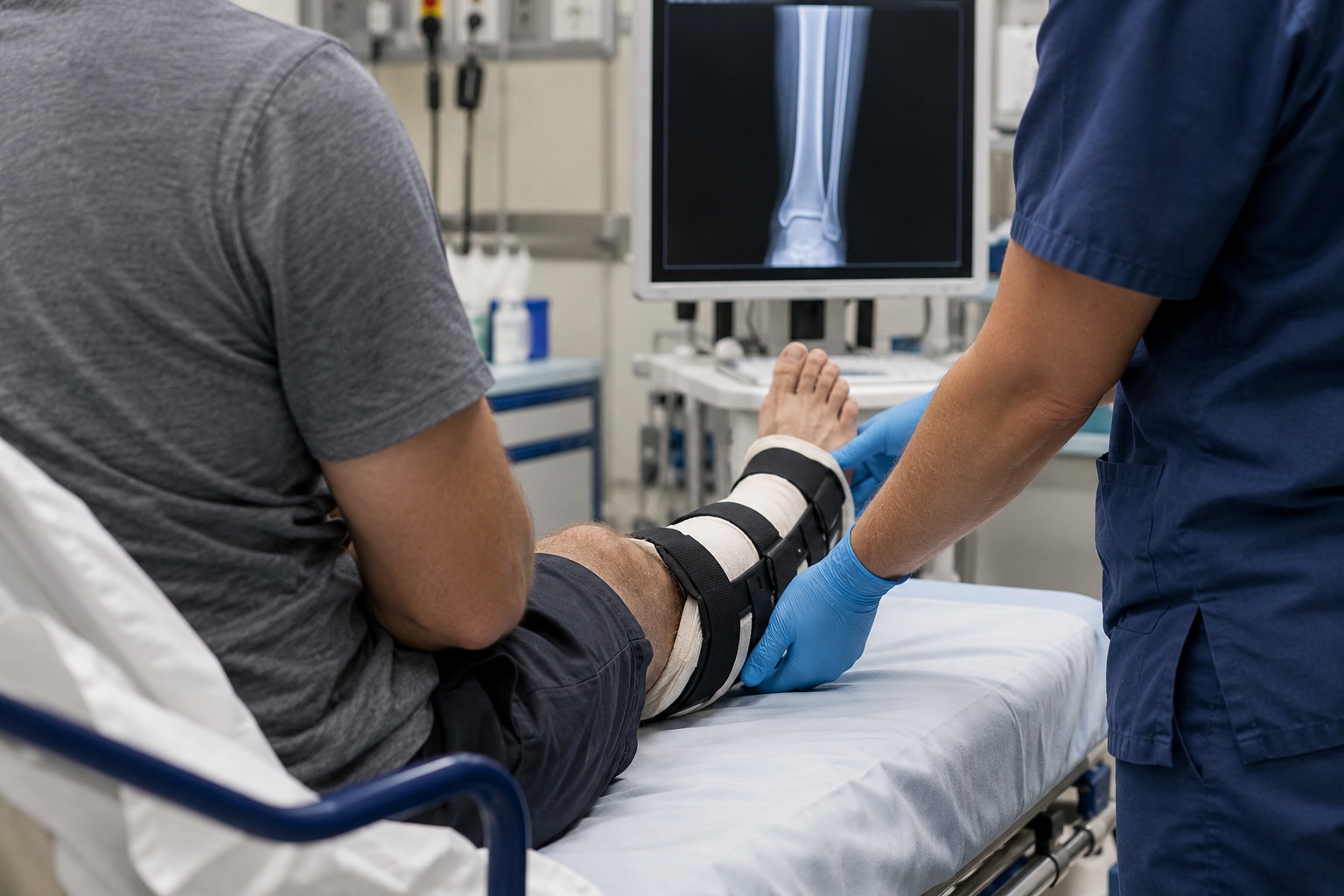
| X-ray | Bone alignment and breaks in appropriate views | First assessment of many limb, joint, pelvis, and spine injuries |
| CT | Detailed bone and joint-surface anatomy | Complex fractures, pelvic injuries, and selected spinal injuries |
| MRI | Bone marrow, nerves, ligaments, tendons, and cartilage | Occult fractures, spinal injury, or soft-tissue damage |
CT, including whole-body CT, is selected from the accident mechanism, examination findings, physiological stability, likely management benefit, radiation exposure, and transport risk. It is not automatic for every accident victim.
A normal first X-ray does not end the investigation when focal tenderness, inability to bear weight, or persistent pain remains. Occult hip, wrist, scaphoid, and spinal fractures can need repeat radiographs, CT, or MRI.
A splint provides temporary protection, not necessarily final treatment. Definitive care depends on alignment, stability, joint involvement, soft-tissue condition, circulation, and your needs. After emergency risks are addressed, The Bone & Joints - Advance Ortho Care 08048067357 is a local option for stable follow-up or assessment by an orthopedic trauma specialist in Thane.
Related services
Orthopedic Trauma Treatment Dr. Vivek V. Shingane is a skilled Orthopaedic and Joint Replacement Surgeon specializing in orthopedic trauma care, fracture management, and... View service → |
Fracture Repair Treatment Dr. Vivek V. Shingane is an experienced Orthopaedic and Joint Replacement Surgeon providing expert fracture repair treatment at The Bone & Joints. View service → |
What should you bring, and which problems need urgent follow-up?
Bring a written handover: record the accident time and mechanism, first aid already given, pain medicines taken, blood thinners, allergies, existing conditions, tetanus history, and every emergency-department X-ray or report. Collecting documents must never delay urgent care when danger signs are present.
- Accident time and mechanism
- First aid already given
- Pain medicines and doses taken
- Blood thinners, allergies, and existing conditions
- Tetanus vaccination history
- Emergency-department X-rays, scans, discharge papers, and reports
A dirty or deep wound may require a tetanus vaccine or tetanus immunoglobulin, depending on the wound type and vaccination history. Antibiotics do not replace thorough cleaning, tetanus prevention, or necessary surgery.
| Problem after discharge | What it may indicate | Action |
|---|---|---|
| Increasing pain, numbness, tingling, inability to move fingers or toes, marked swelling, or pale, blue, or cold digits after a cast or tight splint | Excessive pressure or impaired circulation | Seek urgent reassessment |
| Persistent swelling, deformity, inability to use the limb, or pain that does not improve despite a normal first X-ray | Occult fracture, displacement, tendon or ligament injury | Arrange prompt review |
| Stable pain with no warning signs | Healing injury needing monitoring | Attend planned follow-up |
A trauma orthopedic doctor in Thane should reassess alignment, wound and infection status, healing, stiffness, nerve and tendon function, and rehabilitation needs. Do not dismiss worsening symptoms as normal cast discomfort.
Frequently asked questions
Which accident injuries require emergency help immediately?
Call India’s unified emergency number 112 for severe bleeding, breathing difficulty, loss of consciousness, seizures, suspected head or spine injury, a deformed limb, an open fracture, loss of blood supply, or sudden weakness or numbness.
What should you do before the injured person reaches hospital?
Move the person only when danger remains at the accident site. Control external bleeding with firm pressure, keep the person warm, support the injured area in its current position, and do not straighten a deformity or give food and drink.
When is an emergency department necessary, and when is same-day orthopedic review enough?
Use an emergency department for life-threatening symptoms, possible head or spine injury, open fractures, uncontrolled bleeding, severe deformity, or numb and cold limbs. Arrange same-day orthopedic review for stable pain, swelling, bruising, or suspected closed fractures when no danger signs are present.
How will the injury be assessed when you arrive?
The clinical team checks breathing, circulation, consciousness, bleeding, skin colour, pulses, sensation, movement, and the injured area. They may order X-rays, ultrasound, CT, or MRI based on the suspected injury.
What should you bring, and which problems need urgent follow-up?
Bring identification, current medicines, allergy details, medical records, accident information, and any scans or discharge papers. Seek urgent follow-up for increasing pain or swelling, fever, wound discharge, numbness, colour change, worsening weakness, or a loose splint or cast.
Keywords