A new lump on your wrist or hand may be a ganglion cyst, but appearance alone cannot confirm it. You will learn how to recognise warning signs, what an assessment involves, which treatments to compare, and how to choose appropriate specialist care in Thane.
Key takeaways
- A ganglion cyst often changes size with wrist activity and rest.
- Seek prompt assessment for a painful, rapidly growing, red or immobile lump.
- Diagnosis may require an examination, ultrasound or MRI to rule out other lumps.
- Observation, aspiration and surgical excision suit different symptoms and recurrence risks.
Could your wrist or hand lump be a ganglion cyst?
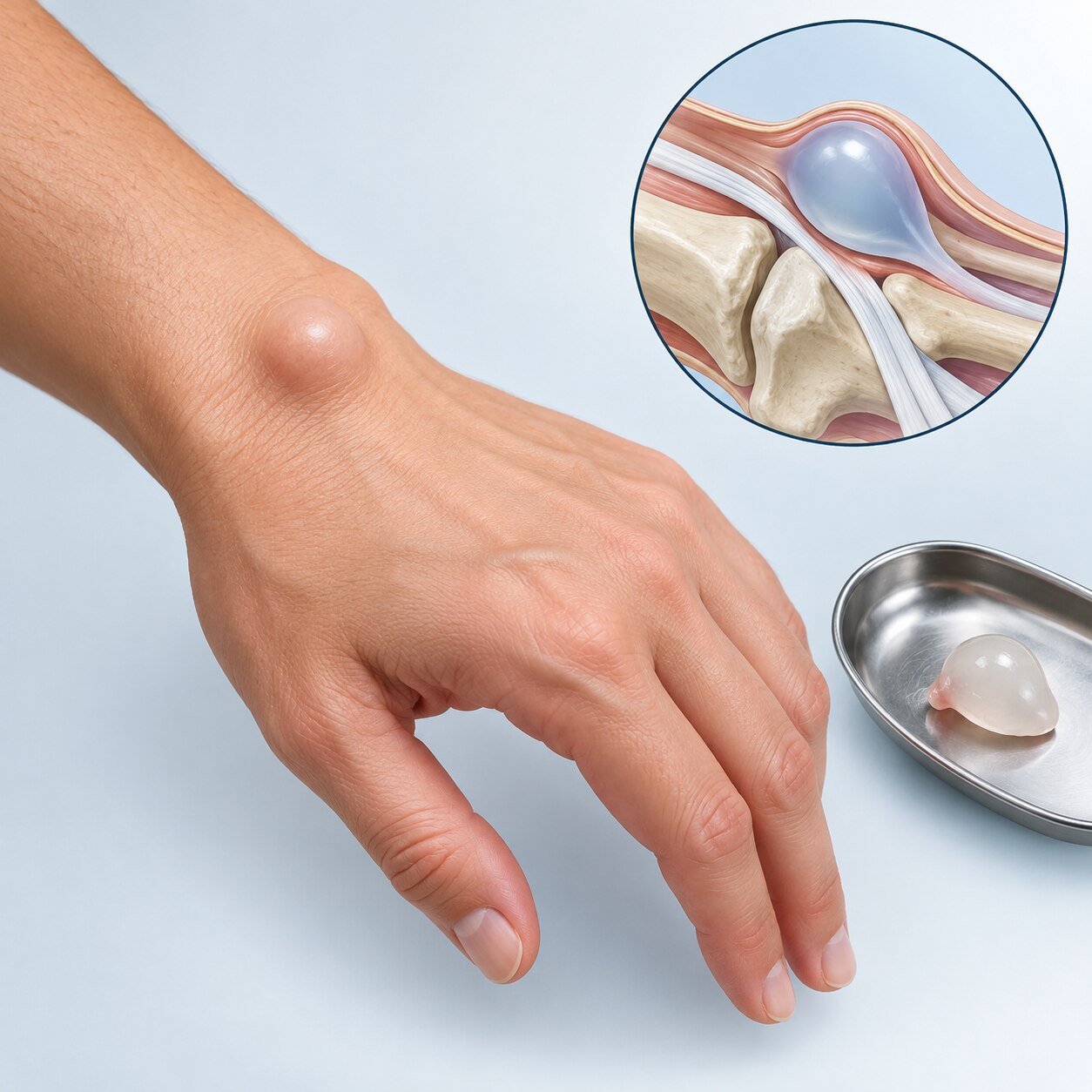
A smooth, round lump that feels firm or rubbery, sits beside a wrist joint or tendon, and changes size with activity is often a ganglion cyst. It contains joint or tendon-sheath fluid, most commonly appears on the back of the wrist, and can become more prominent after use or smaller with rest.
Some cysts are painless; others cause aching, pressure or restricted movement.
Location and behaviour provide clues, not a diagnosis. A palm-side wrist cyst deserves careful assessment because the radial artery may lie nearby. A clinician may check whether the lump moves with a tendon, changes when you move the joint, or allows light to pass through it, but these signs cannot reliably identify every mass.
| Ganglion cyst | Fluid-filled lump near a joint or tendon sheath; size may fluctuate | Common on the back or palm side of the wrist, finger joint or near a tendon |
|---|---|---|
| Tendon-sheath cyst | Small, firm cyst attached to a finger tendon sheath | Usually near a finger joint or along the palm-side tendon |
| Lipoma or epidermoid cyst | Soft fatty lump or skin-lined lump; usually does not vary with wrist use | Often lies within soft tissue rather than directly over a joint |
| Arthritis-related swelling | Thickened joint, bony prominence or inflamed tissue | Accompanies stiffness, tenderness or reduced joint movement |
A solid tumour, infection, vascular swelling or trauma-related lump can resemble a ganglion. A ganglion cyst doctor in Thane should examine the lump before you squeeze, puncture or strike it; those actions can damage skin, nerves, vessels or the joint.
Which wrist or hand lumps need prompt medical assessment?
A new lump needs prompt assessment when it changes quickly, hurts persistently, or affects how your hand works. Do not assume it is a ganglion cyst from its appearance alone.
| Urgency | Signs | What to do |
|---|---|---|
| Same day | Redness, warmth, drainage, fever, severe pain, or rapidly worsening swelling | Contact urgent care; infection may need treatment |
| Prompt appointment | Rapid growth, a hard or fixed mass, unexplained night pain, numbness, tingling, weakness, or marked loss of movement | Arrange medical assessment soon rather than self-treating |
| After assessment, monitoring may fit | Small, painless, stable lump with normal movement and sensation | Follow the clinician’s review plan and watch for change |
Seek assessment after significant trauma, especially if the lump appeared with bruising, deformity, severe tenderness, or difficulty moving the wrist or fingers. A fracture, tendon injury, blood-vessel problem, or other mass can resemble a cyst.
Palm-side wrist lumps deserve particular caution because the radial artery, nerves, and tendons may lie close to them. Do not puncture or squeeze one yourself; aspiration can be unsafe when its position is uncertain.
If you are searching for a hand lump specialist near me, choose a clinician trained in hand, wrist, or orthopaedic assessment who can explain what remains uncertain and whether ultrasound or another scan is needed.
How a clinician confirms the diagnosis
A clinician does not diagnose a wrist or hand lump by appearance alone. They ask when it appeared, whether its size changes with activity, and whether you have pain, numbness, weakness, injury or signs of infection. They then inspect and palpate it to judge its consistency, movement and connection to a joint or tendon.
The examination usually includes:
- Checking wrist and finger movement, grip strength, sensation and blood flow.
- Seeing whether the lump changes when you move a joint or tendon.
- Testing whether light passes through it, which supports a fluid-filled cyst.
- Looking for features of a solid mass, tendon problem, arthritis-related swelling, infection or vascular lesion.
A ganglion cyst doctor in Thane should explain when the findings are typical and when they are not. Imaging helps resolve that uncertainty:
- Ultrasound can distinguish fluid from a solid mass and show whether the lump lies near a tendon or blood vessel. It is especially useful for a palm-side wrist lump near the radial artery.
- X-ray does not usually show the cyst itself, but it can reveal arthritis, a fracture, bone changes or another joint problem.
- MRI is useful when the anatomy is complex, the lump extends deeper, or examination and ultrasound do not establish the diagnosis.
A scan is not automatically required for every classic, painless lump. Rapid growth, persistent pain, neurological symptoms or an uncertain examination warrants further assessment before any aspiration or removal.
Observation, aspiration or surgical excision: which option fits?
Observation fits a painless, clinically assessed cyst that does not restrict movement. Aspiration offers quicker decompression, while excision gives the lowest recurrence risk but carries operative risks.
| Option | Benefits | Limitations, recurrence and complications |
|---|---|---|
| Observation | No needle, wound or recovery period; some cysts shrink or disappear without treatment. | The lump can enlarge with activity and cause later pain or pressure. It remains under review if symptoms or its appearance changes. |
| Needle aspiration | A quick procedure that drains fluid and may relieve pain or improve movement without an incision. | It usually leaves the cyst’s stalk attached to the joint or tendon sheath, so recurrence exceeds 50% in some wrist cases. Infection, bleeding and injury to nearby structures are possible; palm-side cysts require particular caution near the radial artery and nerves. |
| Surgical excision | Removes the cyst and aims to remove its attachment, reducing recurrence to approximately 5% to 10% after surgery. | It involves a wound, scar and recovery, with possible stiffness, infection, persistent pain, nerve or vessel injury, and recurrence. It is usually outpatient, not risk-free. |
Excision makes more sense for persistent pain, restricted function, troublesome pressure or repeated return after aspiration. A search for wrist cyst removal in Thane does not make surgery necessary: choose treatment after confirming the diagnosis and discussing the cyst’s position, alternatives and personal recurrence risk with a trained wrist or hand surgeon.
How to choose a ganglion cyst removal surgeon in Thane
Before agreeing to treatment, ask whether the clinician regularly treats wrist and hand conditions, how confident the diagnosis is, and whether ultrasound or MRI is needed. Ask where the cyst’s stalk lies, especially for a palm-side lump near the radial artery.
- What is the chance of recurrence with observation, aspiration and excision?
- What complications could affect sensation, grip, tendons, the radial artery or wrist movement?
- If aspiration fails, what would the next step be?
- How long will wound care, activity restriction and return to work take?
- Who will review persistent pain, numbness, infection or regrowth?
| Option | What it involves | When specialist care is preferable |
|---|---|---|
| Observation | Monitoring a confirmed, painless cyst | The lump is stable and movement is normal |
| Aspiration | Draining fluid with a needle; the stalk often remains | A suitable cyst needs temporary decompression, after checking its position |
| Surgical excision | Removing the cyst and its connection | Repeated recurrence, pain, restricted movement or functional difficulty |
Do not puncture, squeeze or massage the lump yourself. Choose a ganglion cyst removal surgeon in Thane, rather than relying on a “hand lump specialist near me” search result, when the diagnosis is uncertain, the lump is growing, symptoms include tingling or weakness, or the cyst is palm-side.
Those features need wrist or hand assessment before aspiration.
For example, at The Bone & Joints - Advance Ortho Care 08048067357, ask how the clinician distinguishes a ganglion from a solid mass and why the proposed wrist cyst removal in Thane fits its exact location.
Related service
Ganglion Cyst Removal Dr. Vivek V. Shingane is an experienced Orthopaedic and Joint Replacement Surgeon offering expert treatment for ganglion cyst removal at The Bone &... View service → |
Frequently asked questions
Could a wrist or hand lump be a ganglion cyst?
A smooth, firm or rubbery lump beside a wrist joint or tendon may be a ganglion cyst. These cysts contain joint or tendon-sheath fluid and often change size with activity.
Which wrist or hand lumps need prompt medical assessment?
Arrange prompt assessment for a lump that is painful, rapidly enlarging, red, hot, fixed, numbness-producing or associated with weakness or restricted movement.
How does a clinician confirm a ganglion cyst?
A clinician examines the lump, checks wrist and hand movement, and assesses nearby nerves and tendons. Ultrasound or MRI can help distinguish a ganglion cyst from another type of lump.
Is observation, aspiration or surgical excision best for a ganglion cyst?
Observation fits a painless lump that does not limit function. Aspiration removes fluid but the cyst can return. Surgical excision removes the cyst and its connection to the joint or tendon sheath when symptoms persist or the cyst recurs.
How should you choose a ganglion cyst removal surgeon in Thane?
Choose a surgeon who assesses the exact lump, explains non-surgical and surgical options, discusses recurrence and nerve or tendon risks, and provides a clear recovery plan.
Keywords