A serious injury needs the right level of care before anyone discusses a routine appointment, a cast, or surgery. You will learn how to recognise an emergency, protect the injured person during transport, and choose a Thane service that can provide assessment, imaging, reduction, admission, or transfer when required.
Key takeaways
- Call 112 for open, displaced, spinal, pelvic, or limb-threatening injuries.
- Keep the injured limb still and do not push exposed bone back into place.
- Choose emergency transport for severe pain, deformity, bleeding, or loss of sensation.
- Expect examination, X-rays, and treatment planning based on stability and tissue damage.
Which injuries need emergency trauma care rather than a routine appointment?
Call 112 or go directly to a hospital emergency department for an open fracture with exposed bone or a wound, a displaced fracture, joint dislocation, pelvic or spinal injury, limb-threatening crush injury, tendon rupture, or major ligament injury.
An orthopaedic trauma specialist in Thane or an orthopedic trauma doctor in Thane is not an adequate first stop when the injury could threaten life, the limb, or the spinal cord.
Seek emergency help immediately for:
- Uncontrolled bleeding, shock, breathing difficulty, or altered consciousness
- Severe head, chest, abdominal, neck, or back pain
- Paralysis, loss of sensation, or a new inability to move
- An absent pulse, blue or cold fingers or toes
- A limb that looks pale, severely deformed, or rapidly swollen
| Situation | First destination | Why |
|---|---|---|
| Suspected life-threatening trauma | Ambulance and hospital emergency department | Emergency medicine, anaesthesia, radiology, and resuscitation must begin without delay |
| Open, displaced, unstable, or dislocated injury | Hospital emergency department | The patient may need imaging, reduction, splinting, antibiotics, admission, or surgery |
| Suspected pelvic, spinal, crush, or nerve-and-blood-vessel injury | Ambulance and major trauma hospital | Neurosurgery, vascular surgery, plastic surgery, and orthopaedic teams may need to work together |
| Stable injury after emergency causes are excluded | Routine orthopaedic appointment | Specialist review is appropriate once breathing, circulation, consciousness, and limb viability are safe |
What should you do before an ambulance or hospital transport arrives?
Keep the person still, assess danger, and ask someone to call 112 while you provide basic first aid. This applies after a road crash, fall, workplace injury, or sports accident.
1. Call 112 immediately for severe bleeding, breathing problems, unconsciousness, suspected neck, spine, or pelvic injury, or a limb that is cold, blue, numb, or pulseless.
2. Apply firm, direct pressure over and around bleeding with a clean cloth or dressing. If blood soaks through, add another layer without removing the first.
3. Cover an open fracture with a sterile dressing. Do not push bone back, probe the wound, remove an embedded object, or repeatedly irrigate the wound.
4. Keep the injured person warm with a blanket, but do not give food or drink when surgery may be needed.
5. Immobilise an injured limb in the position found using a padded splint that supports the joints above and below the injury. Before and after splinting, check and record finger or toe colour, warmth, sensation, and movement.
6. For suspected neck or spinal injury, do not encourage walking, repeatedly move the neck, or transport the person unrestrained. Do not straighten a deformity.
Record what happened, the time of injury, and every circulation check for the ambulance team. Trauma injury treatment in Thane begins safely when transport and emergency assessment match the injury.
How do you choose between an ambulance, hospital emergency department, and orthopaedic specialist?
Match the destination to the danger. Call an ambulance when the person has shock, breathing difficulty, altered consciousness, major bleeding, suspected head, chest, abdominal, pelvic, or spinal trauma, or a limb with absent circulation. These injuries need transport, monitoring, and multiple hospital teams.
| Option | What it provides | When it applies |
|---|---|---|
| Ambulance | Stabilisation during transport and direct hospital transfer | Shock, breathing difficulty, altered consciousness, major bleeding, major trauma, or an absent pulse |
| Hospital emergency department | Triage, imaging, reduction, antibiotics, and urgent surgical assessment | Open fracture, dislocation, unstable fracture, crush injury, compartment syndrome, or new neurological symptoms |
| Orthopaedic consultation | Specialist review and planned treatment | After emergency causes are excluded, or for a stable injury needing review |
If you are searching for an orthopaedic emergency specialist near me, ask whether the service provides:
- Urgent neurovascular examination
- On-site X-ray and access to CT or MRI
- Dislocation reduction and splinting
- Open-fracture antibiotics
- Operating-room support and anaesthesia
- Blood services, intensive care, and inpatient admission
- Emergency transfer arrangements
An orthopaedic trauma specialist in Thane may assess and coordinate care, but a clinic can still need to transfer major trauma if it lacks an operating theatre, blood services, intensive care, or hospital admission. Before attending The Bone & Joints - Advance Ortho Care 08048067357, confirm which of these capabilities match the injury.
Related services
Orthopedic Trauma Treatment Dr. Vivek V. Shingane is a skilled Orthopaedic and Joint Replacement Surgeon specializing in orthopedic trauma care, fracture management, and... View service → |
Fracture Repair Treatment Dr. Vivek V. Shingane is an experienced Orthopaedic and Joint Replacement Surgeon providing expert fracture repair treatment at The Bone & Joints. View service → |
What happens during assessment, imaging, and initial treatment?
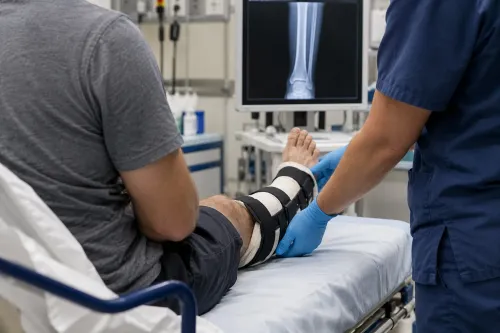
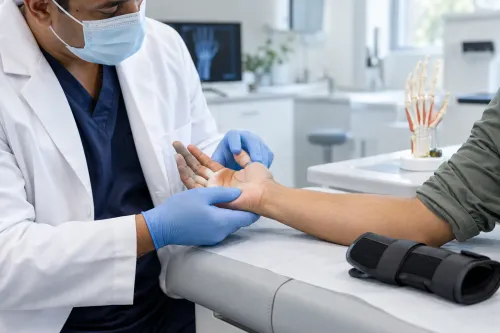
1. Triage and a primary survey come first: clinicians check airway, breathing, circulation, consciousness, and life-threatening bleeding before focusing on the limb. They then provide pain relief and record skin condition, swelling, deformity, distal circulation, sensation, and motor function.
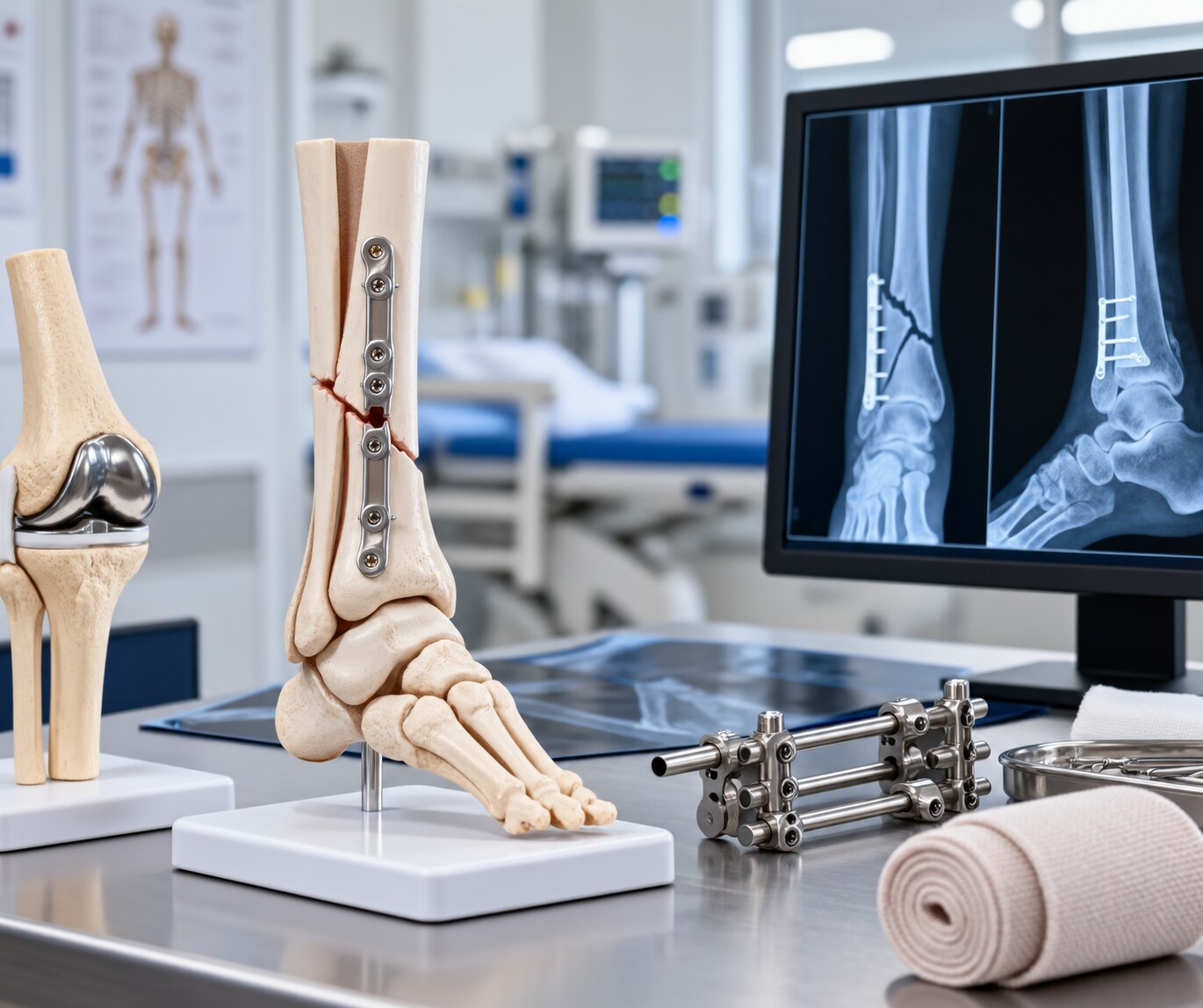
2. X-rays show most fractures and dislocations in two or more views. CT is useful for complex fractures, pelvic injuries, and suspected spinal trauma; MRI can reveal selected occult fractures, tendon or ligament injuries, and spinal-cord problems when examination and X-rays do not explain the symptoms. A normal initial X-ray does not exclude serious injury.
3. The team repeats circulation, sensation, and movement checks after splinting or reduction. Escalating or disproportionate pain, pain on passive finger or toe stretch, increasing tightness, numbness, or weakness suggests compartment syndrome; a normal pulse or initial X-ray does not rule it out. Report these changes immediately.
4. A dislocation may need reduction with analgesia or sedation, followed by splinting. Temporary splinting or external fixation protects an unstable injury. An open fracture needs urgent antibiotics, sterile coverage, and operating-theatre debridement; do not probe or repeatedly irrigate it in the emergency department.
For trauma injury treatment in Thane, an orthopedic trauma doctor in Thane should coordinate hospital-based care when these findings are present.
How is the final treatment plan chosen, and what should follow-up include?
The plan depends on alignment, stability, skin, circulation, nerves, joint damage, and your functional needs—not on the X-ray alone.
| Option | What it means | When it applies |
|---|---|---|
| Observation | Examination and repeat imaging | Stable injury with acceptable alignment |
| Cast | Rigid protection | Stable fracture needing immobilisation |
| Brace | Removable support | Controlled movement is safe |
| Traction | Gradual pulling to restore position | Selected fractures or temporary stabilisation |
| Closed reduction | Realignment without an incision | Dislocation or displaced fracture that can be corrected |
| Open reduction and internal fixation | Surgery using plates, screws, or nails | Alignment cannot be maintained or the joint surface is involved |
| External fixation | Pins connected to an outside frame | Open, severely swollen, unstable, or contaminated injury |
Surgery becomes more likely with an open or unstable fracture, threatened circulation or nerves, or loss of acceptable alignment after reduction. An orthopaedic trauma specialist restores bone, joint, soft tissue, and limb function.
Joint replacement is not the default for an acute fracture in a younger person or an otherwise healthy joint; consider it when reconstruction is impossible or for selected fracture patterns.
Your written follow-up plan must specify:
- permitted movement and weight-bearing
- cast or wound review dates
- when physiotherapy starts
- warning signs requiring earlier review
Prolonged immobilisation causes stiffness, muscle loss, skin problems, and selected clot risks. Seek urgent reassessment for fever, discharge, foul odour, worsening pain under a cast, increasing swelling, new numbness, or inability to move digits.
If searching for an orthopaedic trauma specialist in Thane or an orthopaedic emergency specialist near me, ask about imaging, reduction, admission, surgery, and transfer capability.
Frequently asked questions
Which injuries need emergency trauma care rather than a routine appointment?
Call 112 or go to a hospital emergency department for an open fracture, displaced fracture, joint dislocation, pelvic or spinal injury, limb-threatening crush injury, tendon rupture, or major ligament injury. Seek emergency help for uncontrolled bleeding, a cold or pale limb, loss of sensation, or inability to move the fingers or toes.
What should you do before an ambulance or hospital transport arrives?
Keep the person still, control bleeding with clean direct pressure around—not over—an exposed bone, and support the injured area with padding. Do not straighten a deformed limb, push bone under the skin, or give food and drink before medical assessment.
How do you choose between an ambulance, hospital emergency department, and orthopaedic specialist?
Use an ambulance for spinal, pelvic, crush, open-fracture, severe bleeding, breathing, or circulation concerns. Go to a hospital emergency department for serious injuries needing urgent imaging or reduction. Contact an orthopaedic trauma specialist for specialist assessment after immediate danger is controlled or when arranging follow-up care.
What happens during assessment, imaging, and initial treatment?
The team checks circulation, sensation, movement, skin, swelling, and wound contamination before ordering imaging. X-rays commonly identify fractures and dislocations; CT or MRI is added when bone detail, joint surfaces, tendons, ligaments, or spinal structures need closer assessment. Initial treatment can include wound care, pain relief, splinting, reduction, antibiotics for open fractures, or urgent surgery.
How is the final treatment plan chosen, and what should follow-up include?
The plan depends on fracture alignment, joint involvement, open-wound contamination, soft-tissue damage, nerve or blood-vessel findings, medical risks, and functional demands. Follow-up should track wound healing, swelling, pain, circulation, repeat imaging, weight-bearing limits, splint or cast care, and the start of physiotherapy.
Keywords