
A wrist or hand lump can interfere with gripping, vibrating tools, lifting and repeated impact, but a visible lump does not automatically require surgery. By comparing observation, aspiration and removal—and matching each option to the cyst’s location and your work—you can plan treatment and a safer return to job duties.
Key takeaways
- Observe a painless, stable cyst when diagnosis is clear and work remains safe.
- Aspiration uses a needle but ganglion cysts recur more often than after removal.
- Surgery removes the cyst and its connection, but recovery takes longer.
- Plan gripping, driving and modified duties around pain, wound healing and strength.
When should a manual worker treat a hand or wrist lump?
A painless, stable lump with a clear ganglion diagnosis can be observed, because some cysts shrink or disappear without treatment. Hand lump treatment in Thane becomes more reasonable when symptoms interfere with safe work or the diagnosis is uncertain.
Consider assessment or treatment when you have:
- Pain or restricted wrist movement
- Pressure from tools, repeated impact or rupture
- Weakness, especially in the dominant hand
- Difficulty gripping, lifting or performing your job safely
- A lump that keeps returning or changes in size
Location matters. A dorsal wrist ganglion sits on the back of the wrist. A volar ganglion lies on the palm side, where the radial artery, nerves and tendons may be close. A retinacular cyst forms near a finger joint or tendon sheath.
A hard, fixed or solid lump is not automatically a ganglion and needs further investigation.
Ultrasound helps assess a palm-side cyst, clarify its relationship to the radial artery, or distinguish a solid mass from fluid. MRI is reserved for atypical findings, diagnostic uncertainty or suspected joint pathology.
Seek urgent assessment for rapid enlargement, redness, warmth, fever, severe pain, numbness, weakness, or a pale, blue or cold hand. Do not puncture the lump yourself or deliberately hit it; this can cause infection, bleeding, nerve injury or damage to nearby vessels.
What happens during ganglion cyst aspiration, and how likely is it to recur?
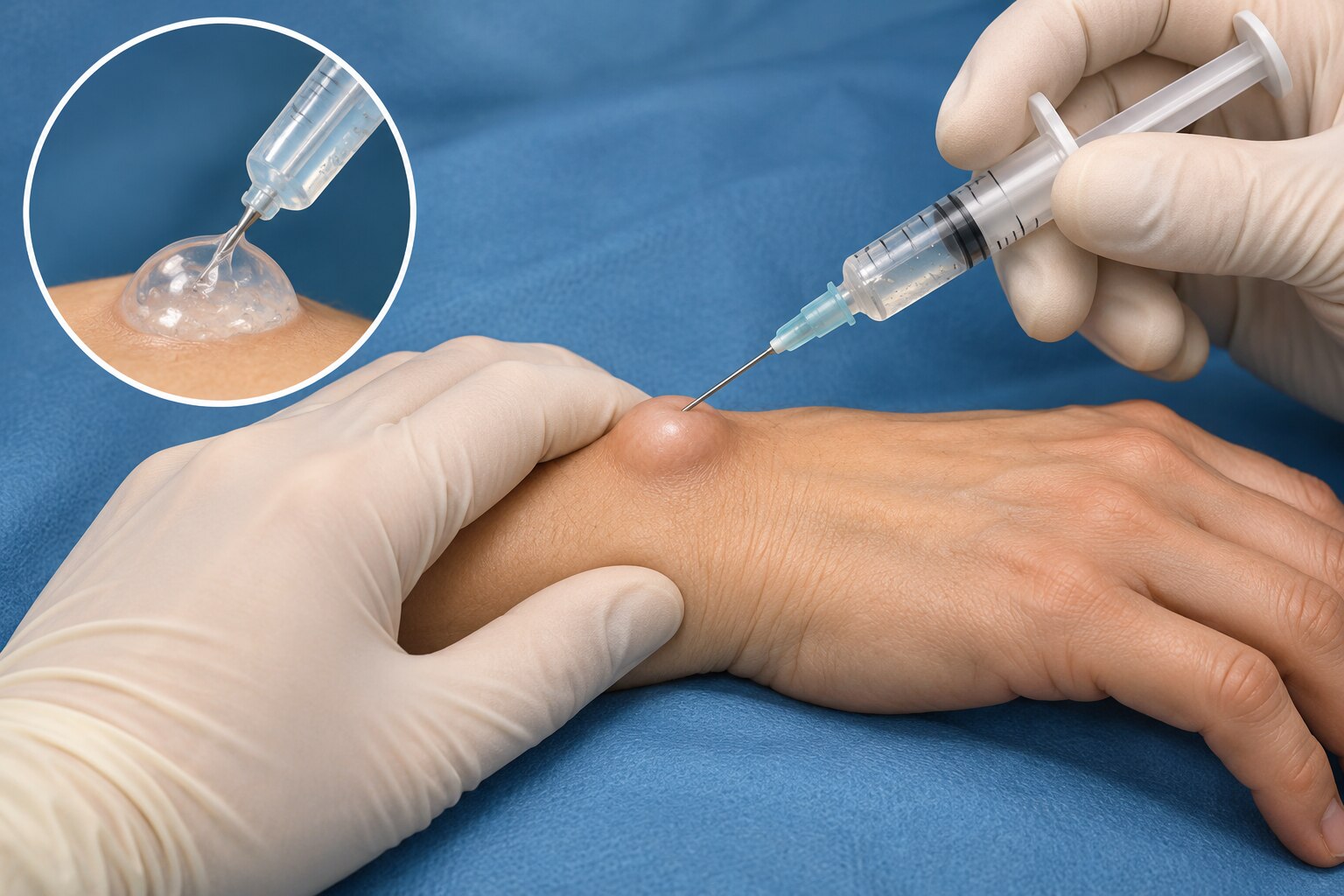
Aspiration usually takes less initial time away from manual work than excision, but it has a higher chance of recurrence. The clinician cleans and prepares the skin, injects local anaesthetic, inserts a needle into the cyst, and drains the jelly-like fluid. The needle is removed and a dressing covers the puncture site.
- Skin is cleaned with antiseptic and the wrist is positioned.
- Local anaesthetic numbs the skin and deeper tissues.
- A needle enters the cyst and suction removes the thick fluid.
- The needle comes out, and a dressing protects the site.
A steroid injection may be discussed after drainage, but trial evidence has not shown a reliable, durable reduction in recurrence compared with aspiration alone. Aspiration usually leaves the stalk or joint or tendon-sheath connection behind. Published wrist series report recurrence of roughly 30% to 70%, depending on location, technique and follow-up.
Infection, bleeding, skin changes and temporary soreness are possible.
Dorsal cyst aspiration is usually simpler than treating a volar cyst beside the radial artery, nerves or tendons. Imaging guidance and experienced hand-and-wrist care matter for a volar lump. This makes wrist cyst aspiration in Thane reasonable when you need shorter initial downtime, but recurrence can cause another interruption.
Discuss ganglion cyst aspiration or removal in Thane with a clinician who can assess the cyst’s exact location and follow you if it returns.
What does surgical removal change compared with aspiration?
For a worker who needs dependable grip, removal is worth considering when recurrence would disrupt work more than a longer recovery. Excision removes the cyst and addresses its connecting stalk or joint or tendon-sheath origin where possible, instead of only draining fluid.
Recurrence after excision is often reported in the low single digits to approximately 10%, but removal is not a guarantee.
| Option | Main advantage | Main trade-off for work |
|---|---|---|
| Aspiration | Smaller immediate intervention and less initial downtime | The stalk remains, so the cyst returns more often; repeat interruption is possible |
| Surgical removal | Better recurrence control by removing the cyst and addressing its origin | A wound, dressing, swelling and temporary limits on gripping, lifting and repetitive wrist loading |
Surgery can leave scar tenderness, stiffness, infection, nerve irritation or persistent pain. Ganglion cyst surgery for workers therefore requires a recovery plan, not just removal of the lump. A volar cyst needs extra caution because the radial artery and nearby nerves or tendons can lie beside it.
Persistent pain after aspiration or surgery may come from a scapholunate-region problem, wrist instability, arthritis or another condition. Check range of motion and stability before treating the cyst as the whole problem.
For ganglion cyst aspiration or removal in Thane, choose assessment that matches the cyst’s location and your job demands: aspiration suits a shorter initial recovery, while removal suits symptoms or recurrence that make dependable grip the priority.
How soon can you grip tools, drive and return to modified duties?
Aspiration often allows light duties sooner, but return depends on needle-site healing, pain and swelling—not a calendar promise. Keep the dressing clean and dry as instructed, and monitor for increasing redness, drainage or worsening pain.
Resume light work when the site is comfortable; delay continuous gripping, heavy lifting, vibrating tools and direct pressure until they do not provoke symptoms.
After ganglion cyst surgery for workers, protect the wound, change dressings according to the surgeon’s instructions and expect swelling and scar sensitivity. Forceful gripping, lifting, kneeling on the wrist and repetitive wrist loading stay restricted until wound healing, motion and grip are adequate.
A ganglion cyst treatment for manual workers in Thane should match these findings to the actual job.
- Start with light tasks: paperwork, inspection, teaching, or tool handling without sustained grip, impact, vibration, heavy loads or palm pressure.
- Set a review date with the clinician and employer to check wound status, pain, wrist motion and grip before adding one demand at a time.
- Increase load gradually; step back if swelling, sharp pain, numbness or reduced movement appears.
Drive only when you can comfortably control a car wheel or motorcycle and are not taking pain medicine that distracts you. You can return to modified duties before full grip strength returns if the employer removes the restricted tasks. Full duties require adequate healing and symptom-free control of the forces your work demands.
How should you choose between observation, aspiration and removal in Thane?
Bring a work profile, not just a photograph of the lump. Record your dominant hand, job title, lifting and grip requirements, vibrating tools, pressure points, kneeling on the wrist, repeated impact, symptom duration, numbness and weakness. These details make ganglion cyst treatment for manual workers in Thane proportionate to the actual risk.
The clinician should confirm the cyst type and document wrist motion, strength, stability and neurovascular findings, especially for a recurrent or volar lump. Request specialist review when the radial artery relationship is unclear, the lump is atypical, aspiration has failed, or reliable grip matters more than the shortest initial downtime.
| Option | Best fit | Main trade-off |
|---|---|---|
| Observation | Painless, stable cyst with a clear diagnosis | No procedure, but symptoms can persist |
| Aspiration | Short-term recovery matters and the location is suitable | Less initial downtime, but recurrence is more likely |
| Removal | Persistent symptoms, substantial work pressure or disruptive recurrence | Better recurrence control, but temporary limits on grip, lifting and wrist loading |
For hand lump treatment in Thane, The Bone & Joints - Advance Ortho Care 08048067357 is one local option for orthopaedic assessment and removal planning. Ask what imaging is needed, whether aspiration suits the location, what task restrictions apply and how recurrence will be followed.
The decision rule is simple: observe a painless stable cyst, consider aspiration when short-term recovery matters, and discuss removal when symptoms persist, work pressure is substantial or recurrence would be especially disruptive. This is the practical choice in ganglion cyst aspiration or removal in Thane.
Related service
Ganglion Cyst Removal Dr. Vivek V. Shingane is an experienced Orthopaedic and Joint Replacement Surgeon offering expert treatment for ganglion cyst removal at The Bone &... View service → |
Frequently asked questions
When should a manual worker treat a hand or wrist lump?
Seek assessment when the lump causes pain, weakness, restricted movement, pressure from tools, or unsafe gripping. Arrange prompt evaluation if it grows quickly, feels hard or fixed, causes numbness, or the diagnosis is uncertain.
What happens during ganglion cyst aspiration, and how likely is it to recur?
A clinician cleans the skin, numbs the area, inserts a needle and withdraws the jelly-like fluid. The cyst can return because aspiration does not remove its connecting stalk; recurrence is higher than after surgical removal.
What does surgical removal change compared with aspiration?
Surgery removes the cyst and its connection to the joint or tendon sheath, reducing recurrence risk compared with aspiration. It requires an incision, wound care and a longer recovery period.
How soon can you grip tools, drive and return to modified duties?
Timing depends on pain, wound healing, grip strength and the procedure. Light modified duties and driving may resume sooner than forceful gripping; follow the surgeon’s restrictions and test controls safely before returning.
How should you choose between observation, aspiration and removal in Thane?
Choose observation for a confirmed, painless, stable cyst that does not compromise work. Discuss aspiration for temporary relief with faster initial recovery, and removal for persistent symptoms, recurrence or work-limiting pressure. A hand and wrist assessment in Thane can confirm the diagnosis and match treatment to your duties.
Keywords